
By Don Blegen
This is one of a number of short stories, based on life in Spring Valley, which are part of the legacy of Don Blegen, who passed on earlier this year. It takes place in the early 1950s, in a setting very familiar to Spring Valley residents. The story is based on real events, although the names have been changed (to protect both those innocent and not).
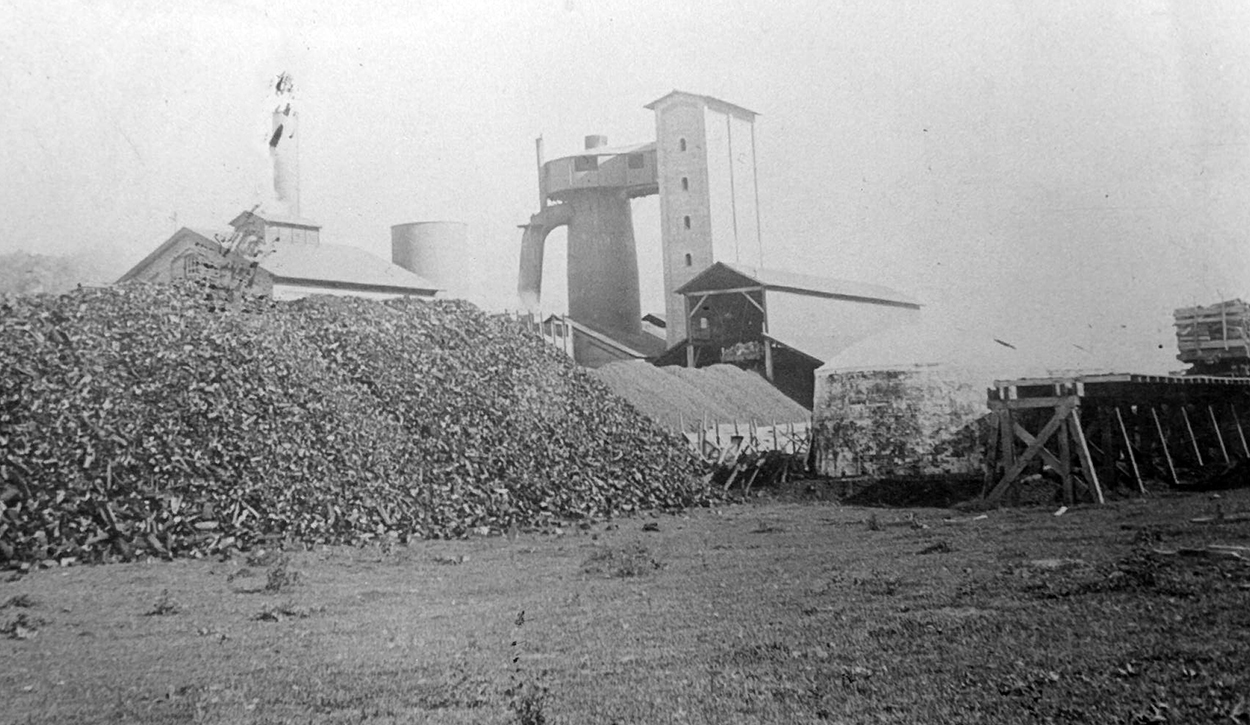
The brick tower, eighty feet high, dominated the village nestled in the valley. It was the last vestige of a complex of buildings that made up the iron-smelting industry that had turned Spring Valley into a boom town many years ago. Everything else was torn down, sold off, scavenged, or salvaged. The tower, used until 1910, survived because it cost more to tear it down than it did to leave it. So, it survived into the 21st Century, a soaring anomaly bordered by a couple of houses on one side and the high school athletic fields on the other. To the south, more houses blended into the business section of town that stretched down along the river valley for several blocks. To the north, open fields extended to the edge of the brush along the river.

Once the tower was the center of a sprawling foundry complex, a hub of industrial activity employing hundreds of men, connected to a railroad spur that brought in a huffing and puffing locomotive pulling dozens of cars twice a day. The entire enterprise was designed to smelt raw iron ore into pig iron. The ore was brought in by rail from nearby open pit mines. The lime flux or catalyst was brought in by rail from a quarry down the river. The coke used for fuel was brought in by rail from out east. The finished pigs of iron were transported out of the village by rail to St. Paul, Milwaukee, or Chicago.
24 hours a day, the smelter complex burned and roared and smoked, sending an eerie light into the night sky. The smelting process separated the pure iron from the impurities in the ore. The molten iron was poured into the pigs and cooled. The impurities were poured off as slag. Men from a dozen countries worked here, trying to get a start in a new land by doing work so dangerous most men would not do it. But when new iron mines were opened up, sources of cheaper iron ore elsewhere, the whole enterprise slowed and finally shuddered to a stop. The foundry buildings were dismantled, the rails melted down, and whatever could be salvaged and sold was shipped out.
The employees moved on to the Mesabi in Northern Minnesota or whatever boom town they could get to. Some had saved enough money to buy some land and try dairy farming or start a business in the village. But most moved on, leaving little evidence of their having lived and struggled here.
Only the tall brick building remained, which everyone called “the smelter.” Really, it was only a part of the smelter complex, just the elevator that moved lime and ore into the furnaces. But the kids of the town didn’t know that, and they didn’t care. To them, it was The Smelter. And it was there to be climbed.
Jim and Ross had decided to climb the smelter early in the afternoon. The chain link fence that was designed to keep out kids was not a problem. Someone had pried up a small portion hidden in weeds and it was easy to wriggle under and in. Older kids had told them that morning where the opening was and that other “fix-ups” had been made to make it easy to get to the top—IF they had the guts. They were going to take that dare and prove that they did have the guts to reach the top and leave evidence of their completing the dare.
It was cooler in the smelter, away from the summer sun. The tower’s exterior was all brick, with window-like openings spaced at each story on the north side. The interior was reinforced by a huge central timber cross-braced with horizontal timbers anchored in the brick. A series of enclosed staircases were fastened to one wall and braced by the cross timbers. The bottom two staircases had been ripped out to keep kids from climbing to the top.
Jim and Ross looked upward, taking this all in. The vertical timber had steps nailed to it, the “fix-ups” mentioned by the older juvenile explorers. The steps went all the way up to the first cross brace. There were eight feet between that cross brace and the stairwell. Too far to jump. A 2×6 plank had been laid across the empty space.
Jim started climbing. Some of the nailed-in struts were a little shaky, but they held. He got up to the cross brace, and Ross followed. They stood on the horizontal timber, one on either side of the big vertical timber, looking at the plank that crossed to the stairwell. When you are twenty feet above the ground, a 2 x 6 looks awfully skinny. And twenty feet down seems a lot greater distance than twenty feet UP.
“I don’t know,” Ross said. “That’s an awful long way down.”
“Aw, we can do it,” Jim said. “Just focus on the board, not the ground.” And he walked across.
“See? Nothing to it.”
Ross hesitated, took one step out, stepped back.
“Come on,” Jim said, “Just DO it.”
Ross tried again, hesitated, and kept on coming.
“See?” Jim said. “Piece of cake!”
They stood together in the lowest stairwell, looking up the stairs, savoring their success, enjoying the coolness, and listening to the pigeons cooing overhead. The rest was easy. They scurried up six flights of stairs to the top of the tower, out of breath and sending flocks of pigeons into panicky flight. They felt like they were on top of the world. Most of the roof had blown off in past storms, giving them nearly 360 degrees of unobstructed view.
The entire village stretched beneath them. Everything looked different from up here, and the boys were stunned by the panorama. But not for long. It was a grand view, but to 14-year-old boys beautiful views do not hold their charm for very long. They noticed names and initials carved into the timbers. Two generations of boys, many now grown and married, some killed in Europe or the Pacific, stared back at them. “GJ”: Gerald Johnson, Jr., killed in the Battle of the Bulge. “ARA”: Alfred Russell “Punky” Allen, his B-17 shot down over Germany. “REP”: Ralph Edward Powell, killed in action in the jungles of New Guinea. These were initials that shone and pulsed with a power that hushed the boys. These men were heroes.
“Hey, look!” Jim said. “There’s my uncle’s name!” After studying the dozens of initials carved and dug into the wood of the structural timbers in a variety of sizes and styles, they got their jackknives out and carved their own initials, adding them to the long list of young men who had defied all the rules, solved all the challenges, and climbed this tower despite all the cautions and orders and threats from their parents and other adults. And to their initials they added the date: “7/15/54.”
When they were finished, Ross said, “I guess we had the guts, didn’t we?”
“Sure did,” Jim said.
Both boys were exhilarated by their daring and their success.
“Look at all those pigeon eggs,” Ross said.
“Lots of pigeons nesting up here,” Jim said.
Ross went over to one of the sloppy nests and took out three eggs.
“What do you think you’re going to do with those?” Jim asked. “Raise your own pigeons?”
“Watch this,” Ross said and whipped one of the eggs down onto the roof of Ralph Gregorson’s house, an easy throw from that height.. It hit the roof and made a beautiful glistening yellow splotch on the purple shingles. Then he fired off the other two. “Splat!” “Splat!”
“You dumbass!” Jim said. “What if they’re home?”
Mrs. Gregorson was indeed home. She had heard the eggs impacting, walked out of her house, backed up some distance so she could see her roof, took in the three yellow splotches on her roof, craned her neck up at the tower for a moment, and went back inside.
“Uh-Oh.” Ross said.
“‘Uh-Oh is right, dummy. She’s probably calling the police right now.”
He’ll never dare to come up here. He’s a grownup.”
“Yeah, and we’ll never get down, either,” Jim said. “You want to spend the rest of your life up here eating pigeon eggs? I’m sure old Mrs. Gregorson is just waiting for us to come tearing outta here so she can see who we are and call our folks. Then what?”
Ross didn’t say anything. It wasn’t the first time a 14-year-old started thinking about something AFTER he had done it.
Sure enough, a couple minutes later, Constable Burt Zauft’s 1949 Ford pulled up to the tower. “Constable Burt and the phy-ed teacher,” Ross whispered. “What’s he doing here?”
“Probably Burt deputized him,” Jim hissed. “Two guys have a better chance of catching us. Now shut up!”
The two men looked upward to the top of the tower, circling the building. “Come on down outta there!” Burt bellowed. “We know you’re up there!”
Silence.
“Come on down from there! If you don’t come down right now, we’re coming up after you!”
Ross began to stifle a laugh, his face turning red, and he began to make little snorting noises. “Shhhhhh!” Jim looked at him with disgust, but Ross’s laughter was so infectious he could not help himself, and soon he was snorting, too. Despite all the stifled snuffling, the men below did not hear them.
They were too busy bellowing dire threats as they circled the tower, waving their arms, looking for some signs of life. The boys didn’t budge, ducked down, invisible from the ground. They were over their giggle fits, more than a little scared now as the seriousness of the situation began to sink in.
When all of the shouts and threats produced no results, the two men jumped in the car and left. The boys peeked over the top of the brick ledge, watching the car as it drove down two blocks, turned, and parked. The men got out and watched the tower. Constable Burt and his deputy were waiting to round them up as soon as they left the building. But the men did not seem to comprehend that the boys had the best observation point in the entire town and could easily see them without being seen themselves.
“Listen up,” Jim said. “If we get down to the bottom and go out that north window, they can’t see us. And if we keep this tower between us and them, backing across that open field, they can’t see us, either. If we make it to the brush along the river, we’ve got it made. They’ll never catch us. But we gotta be sure we keep this tower between us and them!”
“OK,” Ross said. “I just hope Mrs. Gregorson isn’t looking out her window.”
“Can’t do anything about that, except hope she’s not looking—and not waste time. Let’s go!”
Down the staircases they went. Across the plank. Down the strut-ladder to the ground. So far, so good. Out the bottom window hole into the open, walking backwards, feeling naked, hoping against hope that Mrs. Gregorson wasn’t looking, and making sure the tower was between them and the men waiting to pounce.
It seemed to take forever walking backwards over the 200 yards of open field to the brush near the river, but they made it. The boys backed into the nettles, prickly ash, and black raspberry bushes until the brush closed them in and they couldn’t see the tower anymore, getting scratched and stung as they forced their way backward into the tangle.
They were out of sight. No sign of Constable Burt or the teacher. They were safe! Their arms were bleeding from scratches and itching like crazy from the nettles. They didn’t care. Ross grinned at Jim and said in his deepest voice, “Come on down outta there, or we’re coming up after you!” and went into fits of laughter again, no snorts this time, laughing so hard that he fell down, getting scratched and nettle-stung even more. Jim broke down too, both of them on their backs in the brush, laughing and gasping until they were out of breath. Let Constable Burt watch that empty tower all day if they wanted! They had escaped! They had the guts! They had the smarts! And their initials were up there at the top of the tower with all those others—forever!