
Submitted by Danny Akenson, GROWW
PIERCE COUNTY, WI – Several local leaders asked Pierce County’s ad-hoc groundwater committee to look into local ordinances to protect the county from expanding factory farms
The momentum to protect Pierce County communities from the harmful impacts of massive factory farms has become stronger after county residents and farmers urged the Pierce County Groundwater Advisory Committee to investigate local ordinances to protect the county from factory farm expansions. The public pressure comes as Ridge Breeze Dairy, a mega-dairy in the Town of Salem, is attempting to expand to 6,500 cows.

Residents and town leaders from the Towns of Isabelle, Maiden Rock, and Gilman gave the committee powerful testimony about the risks that factory farms pose to groundwater, surface water, and natural resources during an October 20, 2025, meeting. They urged the committee to hear a future presentation on town Operations Ordinances as a potential solution. The towns of Isabelle and Maiden Rock have adopted Operations Ordinances, while Gilman is one of several towns in Western Wisconsin considering adoption. The ordinance ensures local oversight of factory farms.
Judy Krohn, a member of a study group in the Town of Maiden Rock that was the first in the county to recommend adoption of an Operations Ordinance, explained the risks of factory farms polluting the private wells that many county landowners depend on. “In Pierce County, the entire county—including our township—lies atop karst bedrock, which is more easily susceptible to the intrusion and contaminants to the groundwater that fills our well, along with the wells of everyone else who lives in our town,” Krohn said. Krohn pointed the committee to a report from the Wisconsin Groundwater Coordinating Council, which shows that 90% of nitrate contamination is due to application of manure and fertilizers.
Margaret Chesley, who chaired a study group in the Town of Isabelle, said, “With the Operations Ordinance, the town can be involved, not just in monitoring water usage and well testing of nearby wells and surface waters, but in other community concerns such as roads, fire response and financial surety. It is a reasonable, common-sense way to work with an industry that is using our town.” Isabelle’s town board unanimously passed the ordinance last month.
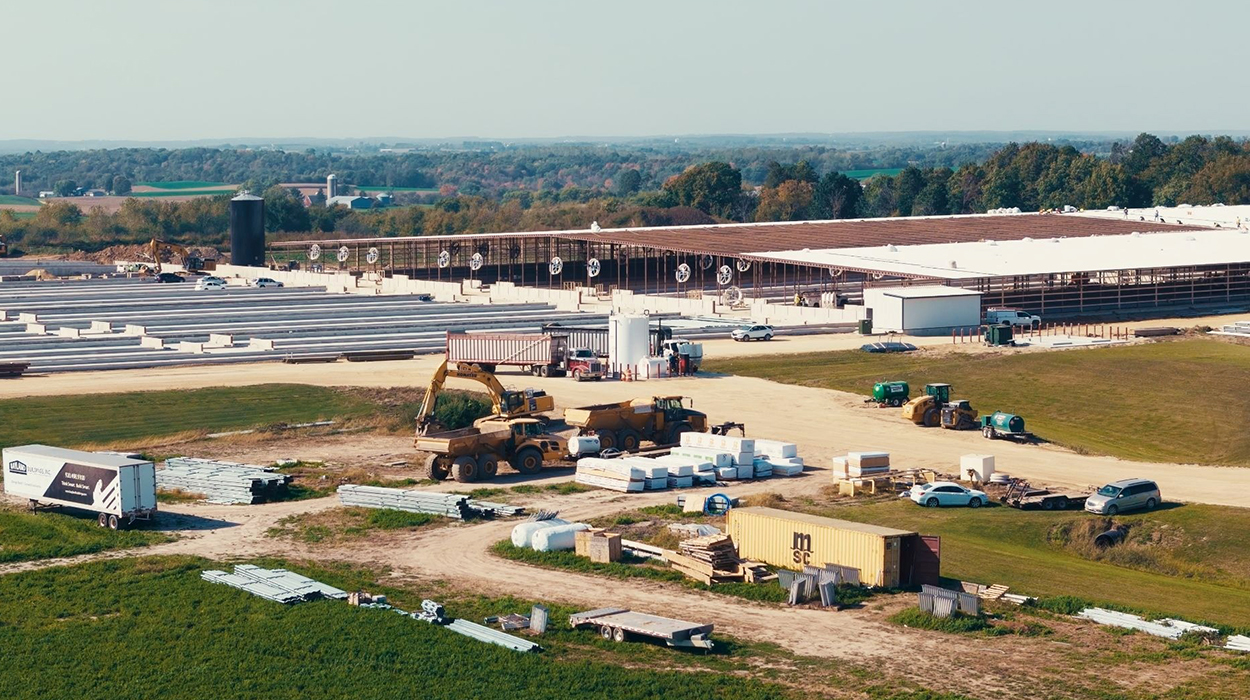
Phil Verges, a lifelong farmer and town board chair in Gilman, detailed the many risks to surface water posed by factory farms like the Ridge Breeze expansion near the Rush River, a world-class trout stream. One such risk is stormwater pouring off the roof of the nearly 500,000-square-foot barn that Ridge Breeze is building.
“Ridge Breeze is not required to have stormwater collection ponds after construction for the roof,” Verges said. Meanwhile, stormwater mitigation requirements are imposed on commercial and industrial sites like warehouses and even smaller operations like Kwik Trip stores.
Another risk Verges pointed to was phosphorus overloading of cropland from the 80 million gallons of manure that Ridge Breeze’s expansion permit would allow Ridge Breeze to spread. Overloading creates the risk of phosphorus “eventually being washed away into nearby waterways and causing algae blooms and other potential health risks,” Verges explained. Under existing regulations, manure application for factory farms is allowed on a field so long as the field tests below 200 parts per million phosphorus. This is roughly five times more than the optimum amount for corn production.
The presenters were followed by several members of the public who reiterated the need for the county to look seriously into concerns about factory farm expansions. Two factory farm owners downplayed the need for stronger regulations during public comment, despite the factual comments brought forward by the presenters and members of the public.
After the presentation, the Groundwater Advisory Committee agreed to hear a future presentation on the Operations Ordinance at a future meeting. The ad-hoc committee has been actively studying concerns around water quality in Pierce County for two years after being formed by the county board in late 2023. They recommended a 5-year well testing program that was approved by the county board earlier this year. Their next meeting is tentatively set for Monday, November 17, 2025, at 6:00 p.m.
GROWW is a grassroots organization based in Western Wisconsin. Together, we work toward a future where we all make ends meet, live with dignity, and have a voice in shaping the decisions that impact us. To get connected or learn more about GROWW, visit us at GRO-WW.org, on Instagram at @GrowWisconsin, or on Facebook at Facebook.com/GROWWisconsin.